
2026 Mid-Year Outlook
The View From Halftime
Every mid-year outlook is really an argument about what the first six months meant. Here is ours, in one paragraph: markets earned their gains this year — corporate earnings genuinely exploded — but the gains were narrow, the price of the market now assumes the good news continues, and the two forces investors spent 2025 counting on (falling inflation and a friendly Fed) both reversed. That combination doesn't demand fear. It demands discipline.
- Stocks delivered. The S&P 500 gained roughly 9% in the first half and set record highs above 7,600, powered by the best single quarter in six years.
- Earnings, not hope, drove it. First-quarter S&P 500 profits grew nearly 28% year over year — with full-year consensus near 23%, the fastest since 2021.
- But leadership was historically narrow. Memory and semiconductor names produced staggering gains while several of yesterday's megacap leaders declined outright.
- Inflation made a U-turn. Consumer prices re-accelerated to roughly 4.25% year over year — the highest in nearly three years — pushed by energy and supply shocks.
- The Fed's next move may be up, not down. A new Chair, a divided committee, and futures markets now assigning real odds to a rate hike — a possibility almost no one priced in January.
The First Half in Review
U.S. equities overcame a war in the Middle East, an oil-supply shock, and recurring anxiety about artificial-intelligence valuations to post one of the stronger first halves in recent memory. After a sluggish first quarter, the second quarter delivered the market's best three-month stretch since 2020.
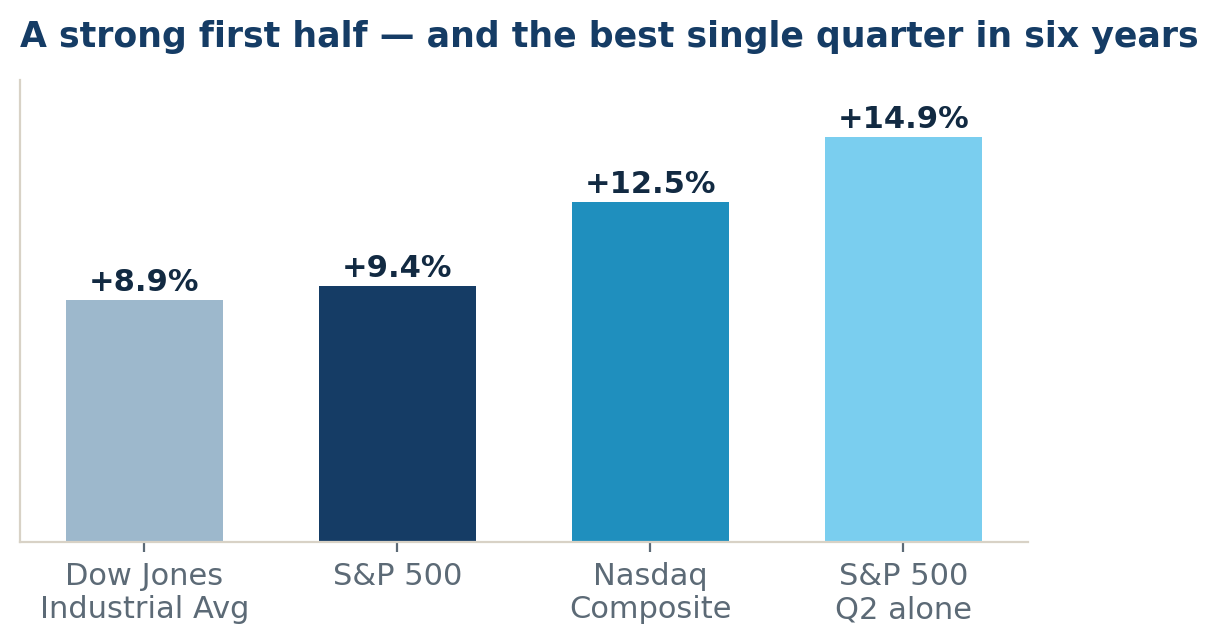
Index price returns, first half of 2026 (S&P 500 second-quarter return shown separately). Sources: index data via LSEG, ABC News, TradingKey; as of June 30, 2026.
Beneath the surface, the character of the market changed. The 'Magnificent Seven' cohort that defined 2024–2025 turned sluggish — Meta fell roughly 15% and Tesla about 7% in the first half — while leadership passed to the semiconductor complex, where the memory-chip names at the heart of AI infrastructure posted gains measured in hundreds of percent. Energy, industrials, and financials broadened the advance.
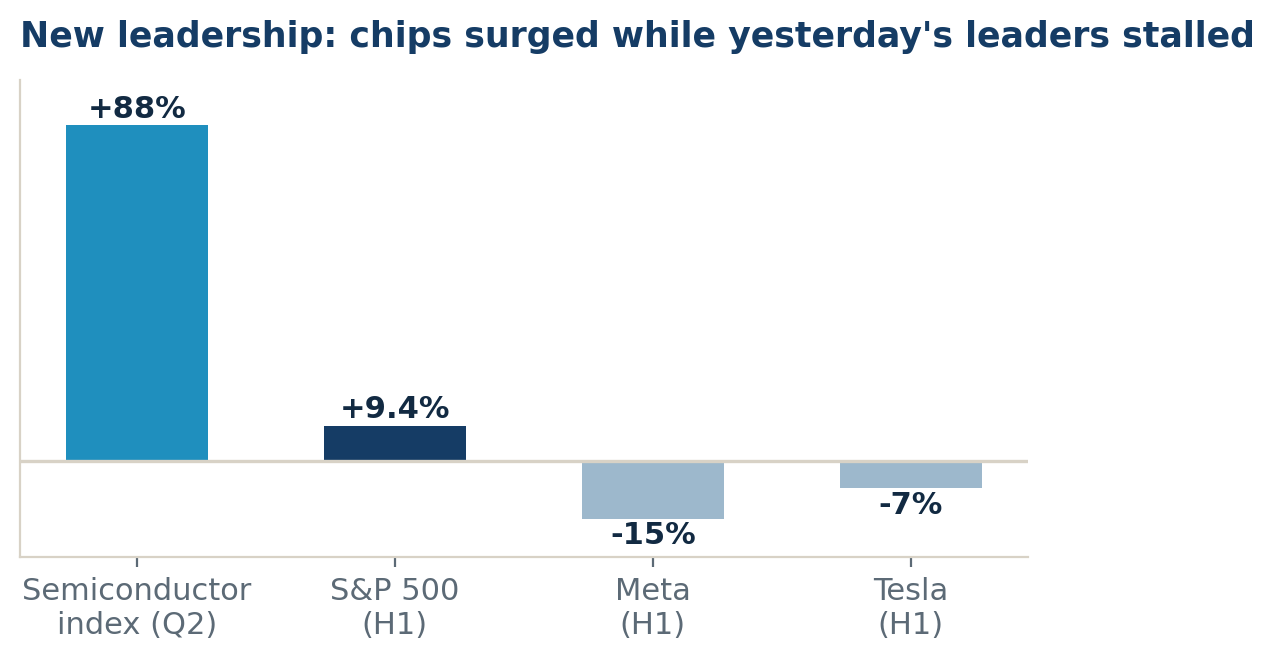
Selected performance: Philadelphia Semiconductor Index (Q2 2026), S&P 500 and selected companies (H1 2026). Sources: index and company data via TradingKey, MarketWatch, ABC News. Past performance does not guarantee future results.
The Economy: Resilient, With an Asterisk
The expansion kept its footing. The economy grew at a solid pace in the first quarter, employers added a healthy average of roughly 114,000 jobs per month through May, and consumers — two-thirds of the economy — kept spending despite elevated prices. June's softer-than-expected jobs report was the first real wobble, and it bears watching rather than panicking over.
The asterisk is inflation. After three years of grinding progress toward the Federal Reserve's 2% goal, consumer prices turned and re-accelerated — to 3.8% year over year by April and roughly 4.25% by June, the fastest pace in nearly three years. Energy costs stemming from the Middle East conflict and related supply disruptions did much of the pushing, but the direction is what matters for policy.
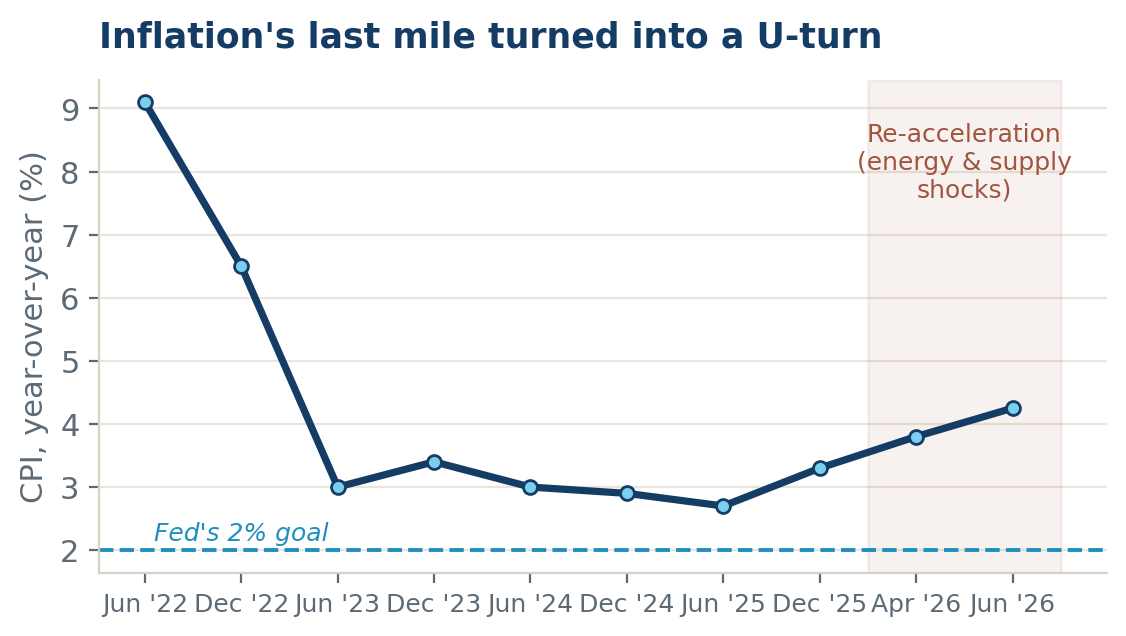
Consumer Price Index, year-over-year change, selected months. Source: U.S. Bureau of Labor Statistics; June 2026 reading as reported via ETF Trends/CNBC.
The Fed: A New Chair and a Two-Sided Risk
The Federal Reserve enters the second half with its benchmark rate parked at 3.50%–3.75%, where it has sat since December, and with a new Chair — Kevin Warsh — who has deliberately offered markets less forward guidance than his predecessors. The committee behind him is described as the most divided in decades.
Here is the change that matters for portfolios: in January, the debate was how many cuts 2026 would bring. By mid-year, futures markets were pricing a path drifting toward 4% by year-end — in other words, a meaningful chance the next move is a hike. Forecasters now genuinely disagree, with some large banks projecting multiple hikes and others none at all.
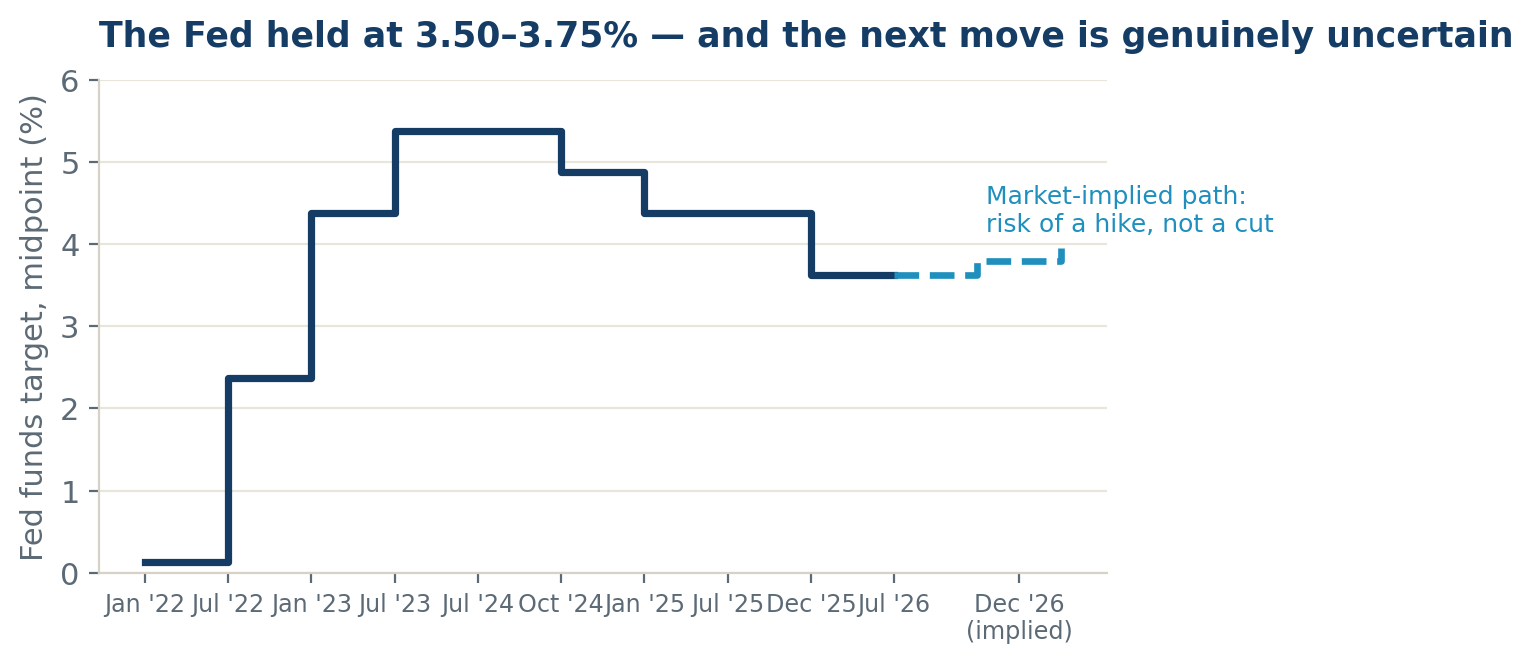
Federal funds target-range midpoint, selected dates, with market-implied path for late 2026. Sources: Federal Reserve; fed funds futures via CME FedWatch and StreetStats; as of early July 2026.
Fixed Income: Income Is Genuinely Back
The quiet good news of 2026 is on the bond side. With the 10-year Treasury near 4.4–4.5% and the 30-year above 5%, investors are being paid real money to lend — a fundamental improvement over most of the last fifteen years. Short maturities yield close to 4% with minimal duration risk, and for retirees building income floors or bridge portfolios, the raw material is the best it has been in a generation.
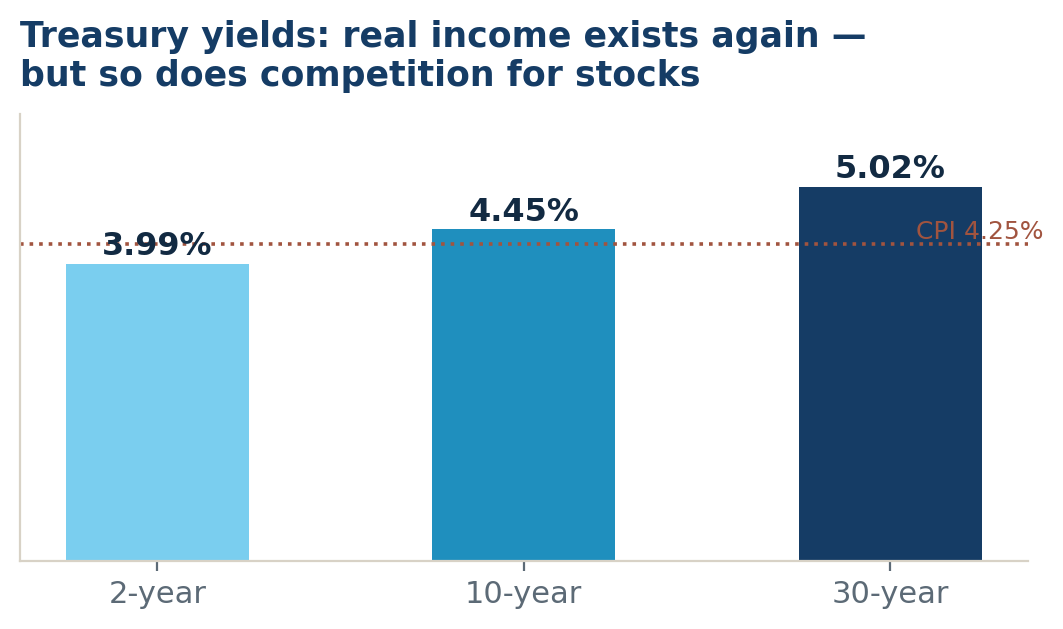
U.S. Treasury constant-maturity yields, early July 2026, versus the June CPI reading. Sources: U.S. Department of the Treasury / Federal Reserve H.15; Tradeweb via Investing.com; BLS.
Two cautions ride along. First, inflation at 4.25% means the after-inflation yield on much of the curve is thinner than the headline suggests — the 2-year currently yields less than trailing inflation. Second, if the Fed's next move is up, longer bonds can lose market value even while paying their coupons. We continue to favor deliberately chosen maturities matched to when the money is actually needed — a ladder built around your spending, not a bet on the direction of rates.
Equities: Paying Up for Real Earnings
The bull case is not imaginary. First-quarter earnings grew at nearly double the pace analysts expected in January, profit margins sit near cycle highs, and revenue growth of roughly 11% would be the fastest since 2022. Companies are earning their way into their prices — at least in aggregate.
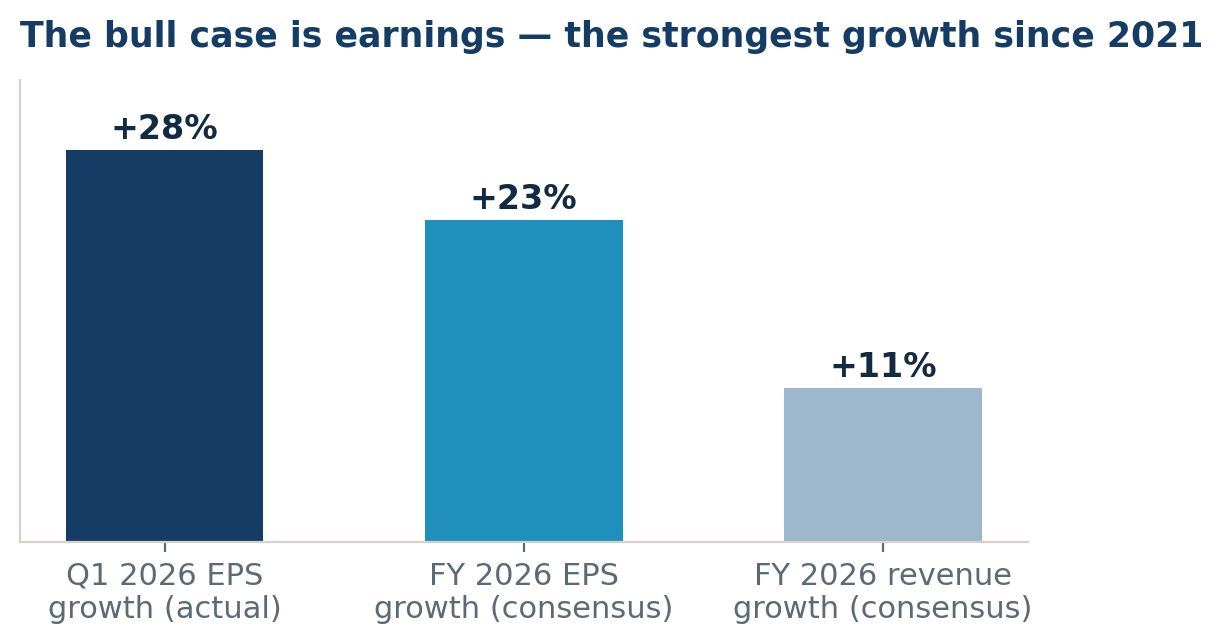
S&P 500 earnings and revenue growth: Q1 2026 actual and full-year 2026 consensus estimates. Sources: Charles Schwab (Bloomberg data, as of 5/1/2026); LSEG consensus via Motley Fool/Yahoo Finance.
The caution is the price of admission. The index trades near 20 times forward earnings — a valuation exceeded in the past four decades only around the dot-com era and the pandemic — and the market's tolerance for disappointment has collapsed: companies missing estimates this season underperformed by nearly 4% the next day, among the harshest penalties in years. Wall Street's median year-end target of about 7,850 implies modest single-digit upside from here. None of that predicts a decline; all of it says the easy part is behind us.
What This Means for Your Plan
- Rebalance on purpose. Strong, narrow gains mean many portfolios are heavier in a few themes than intended. Trimming winners back to target isn't pessimism — it's the plan working.
- Audit your concentration. If semiconductors, AI infrastructure, or a single employer's stock now dominate your growth sleeve, decide the position size deliberately rather than by inertia.
- Put cash to work — thoughtfully. Yields near 4% on short Treasuries and money markets are real, but they trail current inflation. Cash is a tool for near-term spending, not a long-term strategy.
- Revisit rate-sensitive plans. Anyone counting on lower mortgage rates, cheaper borrowing, or falling annuity pricing later this year should stress-test the opposite scenario.
- Near retirement? Respect sequence risk. A market priced for perfection is precisely when a floor under essential income earns its keep — whether built from Treasuries, guaranteed income, or both.
- Harvest the tax angles. Re-accelerating inflation and shifting rate expectations change the math on Roth conversion windows, gain harvesting, and the new 2025–2028 deductions — mid-year is the right time to run those numbers, not December.
Risks We're Watching
- A Fed hike the market only half believes. Tightening into elevated valuations is historically uncomfortable company.
- AI capital-expenditure digestion. The memory-and-chips boom rests on continued infrastructure spending; any pause would hit this year's leaders hardest.
- Energy and geopolitics. The Middle East conflict already re-lit inflation once; oil remains the transmission mechanism to watch.
- Leverage and crowding. Margin debt, options volumes, and leveraged-fund assets all expanded sharply into the rally — fuel on the way up, accelerant on the way down.
- The midterm cycle. November's elections add policy noise in the fall — historically more volatility than lasting direction, but noise nonetheless.
Mountain View Wealth Management, LLC · 6001 Tower Ct., Alexandria, VA 22304 · (571) 368-6178